

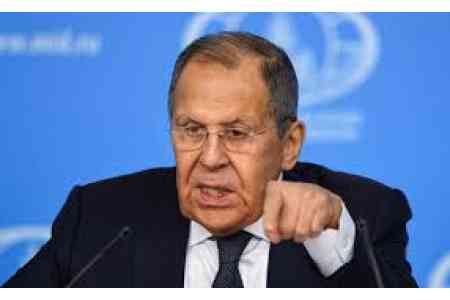
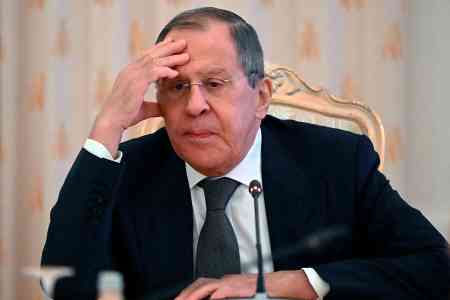
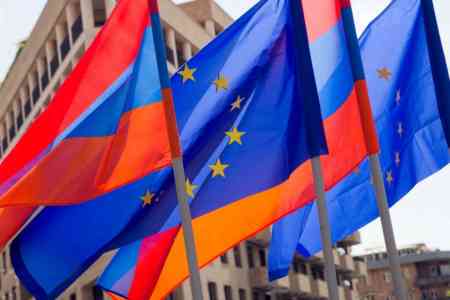
ArmInfo. Armenia cannot adopt EU standards and remain a member of the Eurasian Economic Union (EAEU). Russian Foreign Minister Sergey Lavrov stated this at a press conference on the results of 2025.
He recalled that he had repeatedly discussed Armenia's EU membership and relations with the Eurasian Economic Union with Armenian Foreign Minister Ararat Mirzoyan. He added that he had raised this issue during a meeting with Armenian Prime Minister Nikol Pashinyan during his visit to Yerevan last year.
"Anyone even slightly familiar with the operating principles of the EAEU and the EU will say that it is impossible to adopt EU standards and remain a member of the Eurasian Economic Union," the Russian foreign minister said, adding that Russian Deputy Prime Minister Alexei Overchuk had also repeatedly stated this in his contacts with his Armenian counterpart. Lavrov emphasized that this is simply technically impossible. He stated that these two structures are incompatible not only because they apply different trade and investment regulations that are incompatible, but also because Brussels wants and is actively promoting the idea of transforming Armenia's legal framework in line with its standards.
In this regard, the diplomat recalled that he has repeatedly stated that these standards imply full alignment with EU foreign policy, which implies adherence to anti-Russian sanctions and anti-Russian statements.
Lavrov noted that a new strategic agenda for Armenia's partnership with the EU was signed last December. "It all stipulates the need for coordination in foreign policy, trade, and the economy, and the issue of visa liberalization is being proposed to Armenians. But this is conditioned by the fact that the EU must have a voice in decisions regarding law enforcement and border protection. It is clear that our border guards are stationed in Armenia. The question already arises as to how this fits in with Yerevan's current commitments. Therefore, moving toward EU membership, of course, cannot be compatible with maintaining membership in the EAEU," Lavrov reiterated. He also noted that if Armenia makes the appropriate decision, as Pashinyan said, it will be accepted as in line with the will of the Armenian people-that is the right of the Armenian people and Armenia.
"I simply want to say that it's difficult to ignore the figures that characterize Armenia's economic development over the past 10 years. Armenia joined the EAEU in 2015, when its gross domestic product was $10.5 billion, and now that figure is $26 billion. Armenia's GDP has increased more than twentyfold during its membership in the EAEU," he said.
The diplomat noted that Armenia's unimpeded access to EAEU markets has enabled Armenia's foreign trade turnover with Russia to reach record levels and now stands at $14 billion, a level never seen before. "But, I repeat, it's up to the Armenian people and the Armenian leadership to decide, but combining both is absolutely out of the question," Lavrov concluded.
Earlier, Moscow, through Deputy Prime Minister Alexey Overchuk, stated that it views Yerevan's decision to launch the EU accession process as the beginning of Armenia's withdrawal from the Eurasian Economic Union (EAEU). In December 2025, Overchuk noted that Armenia must at some point make a final decision between the EAEU and the EU. Meanwhile, Armenian Prime Minister Nikol Pashinyan stated on January 14 that Armenia desires to be a full member of the European Union and will remain in the EAEU until compatibility issues arise.





 Political Scientist: As long as the opposition remains silent, Pashinyan can use Plan B and secure a constitutional majority
 US-Iranian memorandum more beneficial for Iran from political and economic perspective - expert
  Political analyst: While Pashinyan pledges peace with Azerbaijan, Baku continues promoting the "Western Azerbaijan" project
 Political analyst: In light of new realities, Yerevan may propose advancing peace process with Baku without constitutional referendum
 Present-day geopolitical competition shifts from territorial control to infrastructure flows
 Zakharova: Russia sent a note of protest to Armenia over the act of vandalism at the "Mother Armenia" memorial in Gyumri
 Samvel Karapetyan proposes creating a post-election opposition coalition
 Artsakh`s Cultural Heritage Ombudsman called on Moscow to respond to destruction of WWII monuments by Azerbaijan in occupied NKR
 Prosecutor General`s Office petitions Central Electoral Commission for criminal prosecution of Robert Kocharyan
 Dutch Prime Minister expresses his support for Armenia`s democratic reform and economic diversification agenda
 Heritage: It`s time for Armenia`s opposition to present people with legitimate alternative to power
 RA Security Council Sec, Assistant to President of Azerbaijan hold negotiations in Dilijan
 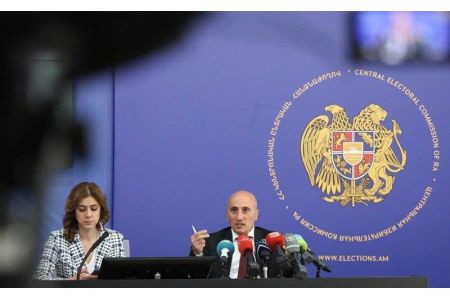 CEC Neutralizes PAP: Three Political Forces to Enter Armenian Parliament Following Election Vote
 Expert: Even OSCE observers recorded numerous violations during elections in Armenia
  Moscow to await official results of Armenian elections - Peskov