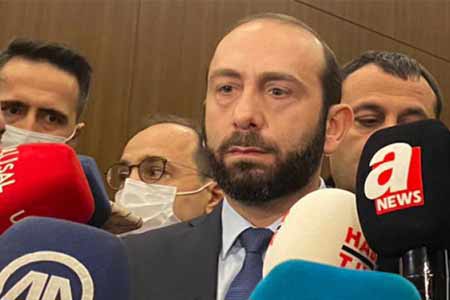
ArmInfo. Next year, the activities of the Ministry of Foreign Affairs of Armenia will be mainly aimed at neutralizing external threats and creating a safe environment, Armenia's Minister of Foreign Affairs Ararat Mirzoyan stated on November 3 during discussions in the commissions of Armenia's National Assembly on the draft state budget of the country for 2024.
According to him, the current year cannot be called successful in a number of areas, since the situation did not develop as we would like. As an example, Mirzoyan cited the mass migration of people from Nagorno- Karabakh, which occurred due to the policy of ethnic cleansing carried out by Azerbaijan, as a result of which today over 100 thousand compatriots have found refuge in the country. The solution to their problems, including with the involvement of international mechanisms, partially lies with the Armenian Foreign Ministry. The main task is to expand international assistance to refugees. "There is no country in the world that, having received thousands of refugees within 3-4 days, went through this period without shocks," the minister said, adding that the quick response of the Armenian government to solving the problems of internally displaced persons surprised many states and international organizations.
Mirzoyan emphasized that the policy of ethnic cleansing and the influx of refugees was an attempt to shift the attention of the Armenian authorities from the main agenda - ensuring a sustainable and stable security environment around the state. Among the main components of this agenda, the minister pointed to peace in the region, which includes normal relations with all four neighbors. Mirzoyan noted that despite the presence of threats and challenges, there are also enormous opportunities to achieve the goal, but it is necessary to move towards it exclusively through peaceful means. In this regard, he pointed to the hopes that were available from the meeting in Granada. Unfortunately, the President of Azerbaijan considered his participation in it inappropriate. "As a result of the quadripartite meeting in Granada, a document was adopted that, by and large, corresponds to the peace agenda of the Armenian authorities, as well as to conclude a peace treaty," the minister said, adding that the sixth round of negotiations with Azerbaijan on the peace treaty is already underway.
The minister noted that the priorities include mutual recognition of the territorial integrity of Armenia and Azerbaijan, the guideline for which should be the data of the Soviet encyclopedia, namely: 29.8 thousand sq. km. the territory of Armenia and 86.6 thousand sq. km of the territory of Azerbaijan. These territories existed in Soviet times, and were enshrined in the Almaty Declaration of 1991. It is also necessary to carry out a process of delimitation and demarcation of borders, which can be carried out on the basis of the most recent maps of the Soviet period 1972-1978. Another principle concerns the unblocking of economic and transport communications of the region. Armenia, as the minister noted, is the most interested country in implementing this principle. At the same time, all transport communications must be under the jurisdiction of the countries through whose territories they pass. In addition, unblocking communications should be based on the principles of reciprocity and equality.















 South Caucasus is entering a new phase of turbulence - ex-official
  Expert: Azerbaijan`s political leadership states `occupation of Armenia is their new national goal`
  Expert: Armenian society falls into security trap of totalitarianism
 Expert: Pashinyan`s visit to Russia creates prerequisites for restoring dialogue, but thaw in relations is more symbolic
 Human rights activist Ruben Melikyan dismissed from YSU
 Pashinyan removed from INNOPROM guest list
 Zakharova: Armenia`s pro-EU pivot poses economic security risks to EAEU member states
 It`s time for South Caucasus countries to think of South Caucasus as single, unified region - RA premier
  Pashinyan: Armenia and Azerbaijan should leave each other alone
 Moscow sees situation with Armenia as attempt to attack Russia-involving integration associations - Russian presidential aid
 Zakharova: Armenia views relations with Russia as tool for financially securing reorientation toward EU
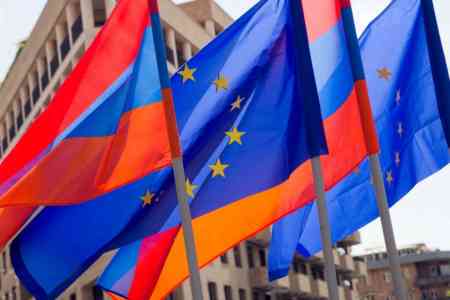 The Armenian Minister of Justice and the EU Ambassador discussed visa liberalization issues for Yerevan.
 Azerbaijan`s aggressive plans against Armenia became possible in wake of Pashinyan`s decisions on Artsakh - expert
  Zakharova: Russia sent a note of protest to Armenia over the act of vandalism at the "Mother Armenia" memorial in Gyumri
 Samvel Karapetyan proposes creating a post-election opposition coalition
 Artsakh`s Cultural Heritage Ombudsman called on Moscow to respond to destruction of WWII monuments by Azerbaijan in occupied NKR
 Prosecutor General`s Office petitions Central Electoral Commission for criminal prosecution of Robert Kocharyan
 Dutch Prime Minister expresses his support for Armenia`s democratic reform and economic diversification agenda
 Heritage: It`s time for Armenia`s opposition to present people with legitimate alternative to power