

ArmInfo. If Armenia's Declaration of Independence hinders the signing of a peace treaty, then the 1991 Constitutional Act of Independence of Azerbaijan will similarly hinder this peace treaty, according to lawyer Ara Zohrabyan.
The lawyer recalled that the goal of the Armenian authorities' initiative to amend the Constitution of the Republic of Armenia is to remove references to Armenia's Declaration of Independence, which is claimed to be an obstacle to peace. The lawyer also questioned whether Azerbaijan would sign a peace treaty if the Armenian authorities succeeded in pushing through a new constitution and proposed that they look into this together. Without political prerequisites and preferences.
"Let's read together Articles 1 and 2 of the 1991 Constitutional Act on the Independence of Azerbaijan: Article 1. "The invasion of Azerbaijan by the 11th Army of the RSFSR on April 27-28, 1920, the occupation of the republic's territory, and the overthrow of the Azerbaijan Democratic Republic, which are subject to international law, are considered the occupation of independent Azerbaijan by Russia." Article 2. "The Republic of Azerbaijan is the legal successor to the Republic of Azerbaijan, which existed from May 28, 1918 to April 28, 1920."
These articles show that modern Azerbaijan is the legal successor to the Republic of Azerbaijan of 1918-1920, and not to Soviet Azerbaijan," Zohrabyan noted. In this vein, he proposed examining the territories Azerbaijan claimed in 1918-1920.
In 1919, the Azerbaijani delegation presented territorial claims at the Paris Conference. The attached map stated that it showed the "present-day and claimed territory" of Azerbaijan. Azerbaijan's official letter of 1919 also mentioned Nakhchivan, Sharur-Daralagyaz (that is, most of Vayots Dzor and the Sharur district of Nakhchivan), and Surmalu, as well as part of the Yerevan region.
In 1920, the Azerbaijani delegation's letter to the League of Nations specifically mentioned Karabakh and Zangezur; the delegation presented them as parts of Azerbaijan under the jurisdiction of its government. "This was the position of the Azerbaijani delegation, not the League's confirmation of the ownership of these territories," the lawyer noted. He noted that on maps of that period, the border line was also crossed by Sevan (in their opinion, Lake Goycha); according to the logic of the map, the eastern part of the lake remained on the side of the territory claimed by Azerbaijan.
Zohrabyan recalled that the League of Nations rejected Azerbaijan's application for membership, and the League's documents noted undefined borders, disputes with neighbors, and uncertainty regarding the position of the Azerbaijani government.
According to him, another noteworthy document demonstrating Azerbaijan's ambitions can be cited in as an example.
Zohrabyan noted that the document jointly distributed by the UN General Assembly and
Security Council, A/64/475-S/2009/508 of October 6, 2009, can be found at the link below. He noted that the first part of the document is a letter dated September 30, 2009, addressed to the UN Secretary-General by the Permanent Representative of Azerbaijan.
"In this document, the representative of Azerbaijan states: '45. Facts show that during 70 years of Soviet rule, Armenia succeeded in expanding its territory at the expense of Azerbaijan and expelling Azerbaijanis from their lands by all possible means. During this period, this policy was carried out systematically and consistently.'
49. Thus, as a result of "Sovietization" "Armenia's territory increased from 8,000-10,000 square kilometers to 29,800 square kilometers, mainly at the expense of Azerbaijani lands." Every Armenian considering the existence and sovereignty of Armenia should know the answer to the question: can today's Azerbaijan sign a peace treaty with Armenia? I have an answer to this question: if Armenia's Declaration of Independence prevents the signing of a peace treaty, then the 1991 Constitutional Act of Independence of Azerbaijan will similarly prevent this peace treaty," the lawyer concluded in his Facebook post.
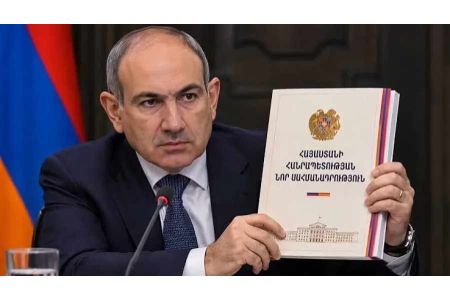
Earlier today, Armenian authorities released a draft of the country's new constitution. The text omits the declaration of independence, which mentions Nagorno-Karabakh, and international recognition of the Armenian Genocide in the Ottoman Empire. In addition, the text contains changes regarding the Armenian Apostolic Church, and states that its activities will be regulated by law, instead of the previous "may be regulated by law." Serious changes have been made regarding the activities of judges, the procedure for depriving a citizen of Armenian citizenship has been established, there are restrictions related to freedom of information, and so on.









































 Expert: Armenia should soberly assess the risks surrounding TRIPP
 Expert: In Armenia, 43% of families with three or more young children are poor—almost twice the national average
 A security sphere expert commented on a video about Papikyan`s achievements during his five years as Defense Minister
 The future of the South Caucasus was discussed in the capital of a country whose problem remains unresolved — Davtyan
 An Armenian orientalist presented possible US actions against Iran
 In several Russian cities, screenings of the film “Monte” have been canceled under pressure from the Azerbaijani lobby.
 Turkish diplomat calls removal of references to the Armenian Genocide from Armenia’s draft new constitution historic
 Ultra-Orthodox Jews continue to desecrate Armenian holy sites in Jerusalem’s Armenian Quarter
 The Yerevan Museum of Russian Art Turns 42
 Armenia and Germany held consultations on defense issues
 Armenia wants to host COP-34 in 2029
 Speaker: Armenia has never approached the CSTO regarding the Karabakh issue
 Lavrov: Armenia will not be expelled from the CSTO
 Drmeyan: The ECHR rejected Azerbaijan`s appeal in the case of Artsakh Defense Army Major Hayk Toroyan
 "Strong Armenia": The brawl in parliament was staged to distract public attention from Pashinyan`s failed foreign policy