


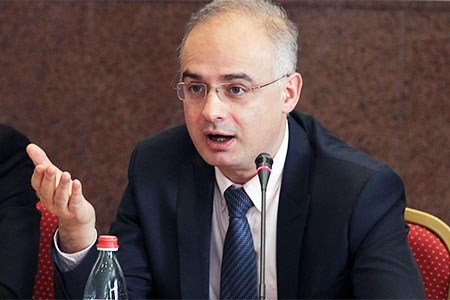
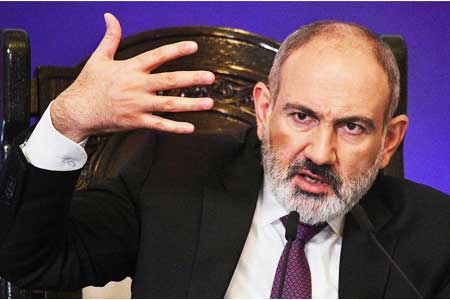
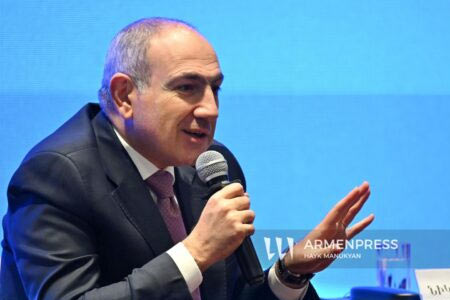
ArmInfo. Deputy Chairman of the Armenian National Congress (ANC) party Levon Zurabyan proposed that Armenian Prime Minister Nikol Pashinyan first resign and only thereafter organize a referendum in the country on the adoption of a new Constitution. He was responding to the Armenian prime minister’s proposal that the opposition go to a referendum and, if the people reject the Constitution he proposed, resign.
"If we did not know who was making this proposal, it could be regarded as constructive—both toward the opposition and toward society. In this way, Pashinyan wants to create the impression that he is ready to sacrifice even his own power for the sake of establishing peace," Zurabyan explained on his Facebook page.
In this regard, he decided to remind everyone that such a proposal had been made by a person who twice—in 2018 and 2021—promised peace and twice brought catastrophic war upon the country. In addition, as the ANC deputy chairman recalled, this is a person who stated in 2019 that there was no peace proposal on the negotiating table and secretly rejected a plan favorable to Armenia that would have made it possible to preserve the de facto independence of Artsakh.
"Instead, he proclaimed: "Artsakh is Armenia, and that’s it!"—and pushed our people toward a predetermined defeat. This is a person who deceived the entire nation, claiming that "the battles in Shushi" were continuing, while he himself was already signing the capitulation. And finally, this is a person who, in the 2026 parliamentary elections, usurped power in Armenia by resorting to mass falsifications, unprecedented repression against the opposition, and the theft of parliamentary mandates carried out by the Central Electoral Commission (CEC). Consequently, he is quite capable of falsifying this referendum, which is fateful for his rule," the politician believes.
He then explained what the proper counterresponse to this "proposal" should be. First and foremost, in his words, Pashinyan must resign, after which a new prime minister should be elected by agreement among the parliamentary factions, and a new composition of Armenia’s CEC should be formed, enjoying the mutual trust of the parties and capable of holding a fair referendum in the country.
"All political prisoners are released to ensure compliance with democratic standards during the referendum. Only one question is put to the referendum: should the reference to the Declaration of Independence be removed from the text of the Constitution? Discussing any other issues at this stage means turning any constitutional reform into a hostage to one question, which in fact is the sole objective of Pashinyan’s initiative, aimed at fulfilling the demand of Azerbaijani President Ilham Aliyev. This is exactly how one should speak with political crooks—briefly and with the utmost specificity," Zurabyan concluded.
It should be recalled that on March 12, 2026, Armenian Prime Minister Nikol Pashinyan stated that the preamble of Armenia’s new Constitution should not contain a reference to the Declaration of Independence. He explained his position primarily by saying that "the current Declaration of Independence is built on the logic of conflict." It is noteworthy that removing the Declaration of Independence is one of Baku’s conditions for Yerevan to sign a peace treaty. Independent experts tend to believe that the Armenian authorities, by initiating constitutional changes, are complying with yet another demand from Baku.
It should be added that, following the regular parliamentary elections held in Armenia on June 7, 2026, the Civil Contract party has a 3/5 majority, which allows it to adopt constitutional laws and make appointments, but the party does not have the 2/3 majority of votes required to make direct amendments to the Constitution of Armenia. It should also be added that after the occupation of Artsakh, demands are frequently voiced from Baku for Armenia to change its Constitution on the grounds that it allegedly contains territorial claims against Azerbaijan. The Azerbaijani side presents the fulfillment of these and other demands as a precondition for concluding a "peace treaty."

















 A security sphere expert commented on a video about Papikyan`s achievements during his five years as Defense Minister
 The future of the South Caucasus was discussed in the capital of a country whose problem remains unresolved — Davtyan
 An Armenian orientalist presented possible US actions against Iran
 Expert: Official Yerevan should not base its calculations in relations with Ankara on the "crack" in the Turkish-Azerbaijani alliance
 Armenia wants to host COP-34 in 2029
 Speaker: Armenia has never approached the CSTO regarding the Karabakh issue
 Lavrov: Armenia will not be expelled from the CSTO
 Drmeyan: The ECHR rejected Azerbaijan`s appeal in the case of Artsakh Defense Army Major Hayk Toroyan
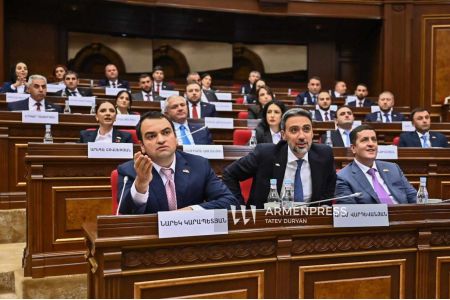 "Strong Armenia": The brawl in parliament was staged to distract public attention from Pashinyan`s failed foreign policy
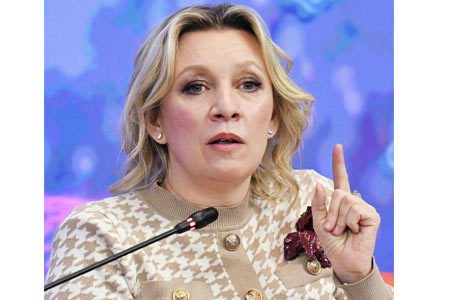 Zakharova commented on the scandalous epithets of the governor of Armenia`s Shirak region about "Ivanov"
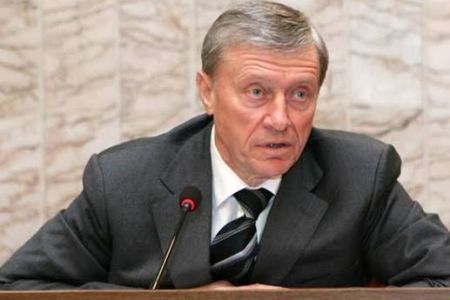 Nikolai Bordyuzha proposed excluding Armenia from the CSTO.
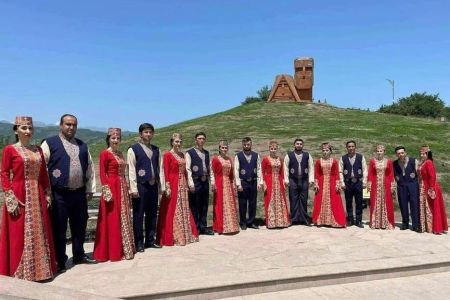 The participation of Artsakh ensembles in an international festival in Vienna was cancelled following the intervention of several foreign embassies
 Expert: It`s time for Armenia to move away from uncertainty and choose between West and East
 The Armenian Foreign Minister commented on the country`s return to work within the CSTO.
 The Artsakh Public Council expressed outrage at the UN Secretary-General`s behavior
 Lukashenko called for Armenia to assume the CIS presidency in 2029
 Dmitry Medvedev predicted a Ukrainian-like fate for Armenia amid the country`s shift in foreign policy
 Russian Security Council: In Armenia, they want to force Russian asset owners to dispose of their assets