
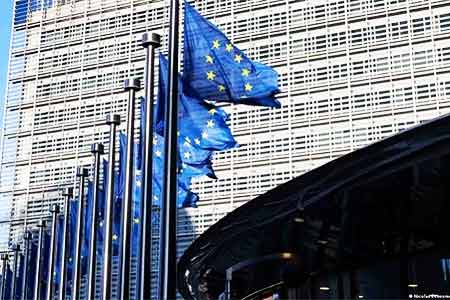
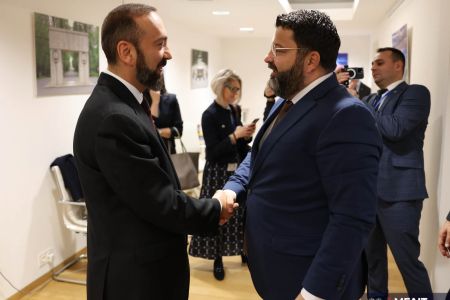
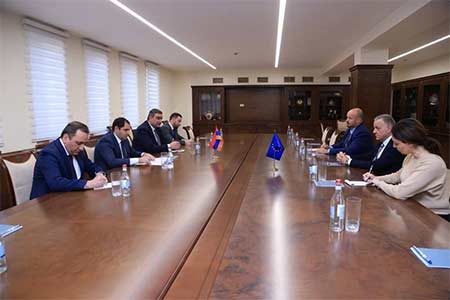
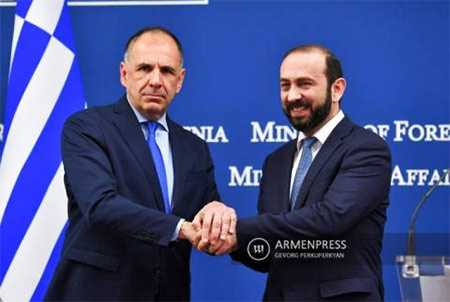
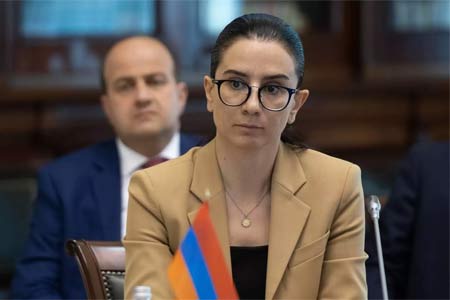
ArmInfo. Armenian Foreign Minister Ararat Mirzoyan participated in a ministerial meeting on "Interregional Security and Connectivity," organized by the European Union.
According to the press service of the Armenian Foreign Ministry, during his speech at the discussion "Implementing Interregional Connectivity," Mirzoyan touched upon the progress achieved in unblocking regional communications since the Washington Peace Summit on August 8, 2025. In particular, the steps being taken within the framework of the TRIPP project, both in terms of providing a legal framework and in terms of on-the-ground work.
Mirzoyan emphasized that the construction and/or restoration of regional communications can bring tangible economic benefits to all countries in the region, emphasizing Armenia's commitment to the principles of inclusiveness and mutual benefit that underlie the Crossroads of the World initiative.
Speaking about Armenia's partnership with the EU in the field of transport infrastructure, the republic's top diplomat emphasized the importance of cooperation in developing border crossings and transport infrastructure, simplifying customs procedures, digitalizing trade, and expanding energy and digital communications. In this context, he emphasized the importance of translating political commitments into concrete, measurable programs that deliver results, with the participation of international financial institutions and the private sector.
Mirzoyan emphasized the importance of developing reliable transport, energy, and digital infrastructure connecting the Black Sea, the South Caucasus, and Central Asia, emphasizing that transport connectivity should serve not only trade and economic development, but also regional cooperation, sustainability, and peace.
The meeting was attended by EU High Representative for Foreign Affairs and Security Policy Kaja Kallas, EU Commissioner for Enlargement Marta Kos, Commissioner for International Partnerships Josef Sikkela, as well as foreign ministers and representatives of EU Member States, Ukraine, Moldova, Turkey, Azerbaijan, and the Central Asian countries of Kazakhstan, Kyrgyzstan, Tajikistan, Turkmenistan, and Uzbekistan.










 The future of the South Caucasus was discussed in the capital of a country whose problem remains unresolved — Davtyan
 An Armenian orientalist presented possible US actions against Iran
 Expert: Official Yerevan should not base its calculations in relations with Ankara on the "crack" in the Turkish-Azerbaijani alliance
 Speaker: Armenia has never approached the CSTO regarding the Karabakh issue
 Lavrov: Armenia will not be expelled from the CSTO
 Drmeyan: The ECHR rejected Azerbaijan`s appeal in the case of Artsakh Defense Army Major Hayk Toroyan
 "Strong Armenia": The brawl in parliament was staged to distract public attention from Pashinyan`s failed foreign policy
 Zakharova commented on the scandalous epithets of the governor of Armenia`s Shirak region about "Ivanov"
 Nikolai Bordyuzha proposed excluding Armenia from the CSTO.
 The participation of Artsakh ensembles in an international festival in Vienna was cancelled following the intervention of several foreign embassies
 Expert: It`s time for Armenia to move away from uncertainty and choose between West and East
 The Armenian Foreign Minister commented on the country`s return to work within the CSTO.
 The Artsakh Public Council expressed outrage at the UN Secretary-General`s behavior
 Lukashenko called for Armenia to assume the CIS presidency in 2029
 Dmitry Medvedev predicted a Ukrainian-like fate for Armenia amid the country`s shift in foreign policy
 Russian Security Council: In Armenia, they want to force Russian asset owners to dispose of their assets
 Zakharova: Russia ready to discuss with Armenia the prospects for expanding military cooperation as part of a review of bilateral ties
 Tevanyan: Armenia, like Ukraine and Moldova, is being drawn into the EU’s global war