
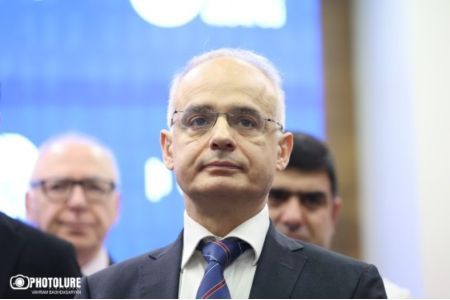
ArmInfo. The British magazine The Critic published an article criticizing the West for supporting the Armenian government's policies to persecute the Armenian Apostolic Church (AAC), reports Levon Zurabyan, deputy chairman of the Armenian National Congress (ANC) party.
The politician presented the main points of the article on his Facebook page, noting that its author writes that Armenian Prime Minister Nikol Pashinyan is establishing a dictatorship in Armenia and illegally persecuting the Armenian Apostolic Church (AAC) and the opposition; that Pashinyan hoped to secure the West's unconditional support; That the West, and especially Europe, represented by European Commission President Ursula von der Leyen and Chief Diplomat Kaja Kallas, are directly supporting the establishment of a pro-Western dictatorship in Armenia.
Zurabyan noted that former Human Rights Watch director Kenneth Roth also voiced criticism, posting the following on the social media site X: "Are European countries really completely happy with Armenian Prime Minister Nikol Pashinyan turning democracy in his country into a dictatorship—as long as it's pro-Western? Apparently, that's exactly it."
At the same time, the ANC deputy chairman noted that the author of the article in the British newspaper The Critic drew attention to the fact that the second National Prayer Breakfast was held in Yerevan in early October. The article notes that the event, which was positioned as an opportunity to "strengthen the country's spiritual foundations and reaffirm its commitment to traditional Christian values," did not include representatives of leading opposition forces or the clergy. However, while traditional prayer breakfasts are intended to foster mutual understanding, it is far from clear that the Armenian event remained faithful to the bipartisan tradition of its American counterpart. Representatives of opposition political forces were virtually absent. Moreover, the event took place during a tense period for the country, when serious concerns are emerging regarding Armenia's commitment to the principles of religious freedom, democracy, and the rule of law. Among these concerns, as the author notes, the fate of the Armenian Apostolic Holy Church—the national church of the Armenian people, whose history spans over 1,700 years—is foremost. In particular, it is noted that today it is under constant attack from the very government that was the main organizer of the prayer breakfast. "Pashinyan seeks to remove and replace the spiritual head of the Church, His Holiness Karekin II, Catholicos of All Armenians. To this end, the Prime Minister is encouraging schism within the Church. Prominent clergy and laity have been arrested and imprisoned, and the Catholicos and six high-ranking archbishops have been charged with criminal offenses and banned from leaving the country. The reason for this is their unwillingness to reinstate a bishop deposed by the Church itself in accordance with canon law. Meanwhile, this issue falls solely within the jurisdiction of the Church. In his speech, Pashinyan addressed this campaign. He called for "the spiritual life of Armenia to leave the Church and enter the streets, homes, markets," as well as "local government bodies, the government, the legislative, executive, and judicial branches of power." Essentially, this was a declaration of a course toward subordinating the Church to the state," the article notes.
The author of the article, pointing out the lack of any grounds for Pashinyan's campaign against the Armenian Apostolic Church, also drew attention to the authorities' attempts to label the Church as an "agent of foreign influence in the person of Russia." Moreover, the article suggests that the basis for the campaign against the Armenian Apostolic Church was the Church's criticism of the Pashinyan government's activities, especially regarding its inability to protect the country's state and national interests.
"The ethnic cleansing of the Armenian population of this territory, carried out by Azerbaijan in 2023, remains a deep, unhealed wound." Armenians have serious concerns about the Prime Minister's ability to achieve a just peace with Azerbaijan. Following the loss of the Nagorno-Karabakh Republic (NKR), Pashinyan is determined to normalize relations with Azerbaijan and Turkey—the state that perpetrated the Armenian Genocide—at virtually any cost. Turkey and Azerbaijan have repeatedly portrayed the Catholicos as an "obstacle to peace" for his advocacy for the rights of Armenian refugees from the NKR. Meanwhile, voicing these concerns directly stems from the Church's constitutionally enshrined "exclusive mission" in preserving the "national identity" of the Armenian people. Subordinating the Church would silence the most influential independent critic of Pashinyan's strategic course—an outcome that would benefit Baku and Ankara," the article states.
The author also points out that the Church is far from the only target of the Armenian government. In this regard, it is recalled that the leaders of Armenia's three largest opposition parties are in custody and, therefore, were unable to participate in the prayer breakfast.
"With the exception of isolated statements, Western political institutions remain silent about both the Church's plight and the broader retreat from democratic principles, while simultaneously welcoming Armenia's proclaimed 'Western' turn. The European Union's silence is particularly noteworthy. In May, just weeks before the elections, the first EU-Armenia summit was held in Yerevan. None of the summit's key participants, including Ursula von der Leyen and Kaja Kallas, raised either of these two issues. Instead, they apparently preferred to view Armenia as a geopolitical trophy rather than a democratic state in need of protection," the author of the article believes.
In conclusion, the article notes that for seventeen centuries, the Armenian Church has been a pillar of its people, helping them survive invasions, expulsions, and genocide, and emphasizes that the West should not leave it alone to face its own government.

















 Expert: Economic pressure on Armenia may be virtually painless for other EAEU members, but not for Armenia itself
 Expert on protests in France: Civilizations fade when society loses a vision of the future
 Turkologist: Azerbaijan is not all-powerful—its vulnerabilities should become part of Armenia’s security strategy
 Opinion: The development of the Amulsar mine near the resort town of Jermuk is the beginning of an environmental disaster in Armenia
 "Strong Armenia": The brawl in parliament was staged to distract public attention from Pashinyan`s failed foreign policy
 Zakharova commented on the scandalous epithets of the governor of Armenia`s Shirak region about "Ivanov"
 Nikolai Bordyuzha proposed excluding Armenia from the CSTO.
 The participation of Artsakh ensembles in an international festival in Vienna was cancelled following the intervention of several foreign embassies
 Expert: It`s time for Armenia to move away from uncertainty and choose between West and East
 The Armenian Foreign Minister commented on the country`s return to work within the CSTO.
 The Artsakh Public Council expressed outrage at the UN Secretary-General`s behavior
 Lukashenko called for Armenia to assume the CIS presidency in 2029
 Dmitry Medvedev predicted a Ukrainian-like fate for Armenia amid the country`s shift in foreign policy
 Russian Security Council: In Armenia, they want to force Russian asset owners to dispose of their assets
 Zakharova: Russia ready to discuss with Armenia the prospects for expanding military cooperation as part of a review of bilateral ties
 Tevanyan: Armenia, like Ukraine and Moldova, is being drawn into the EU’s global war
 Yerevan City Hall is considering introducing a valet parking system in the city
 Expert: The circus surrounding the “Albanization” of Armenian culture in the presence of foreign ambassadors in occupied Artsakh is genocide
 Political scientist: If Russian-Armenian relations are destroyed, Turkey will take Russia`s place