
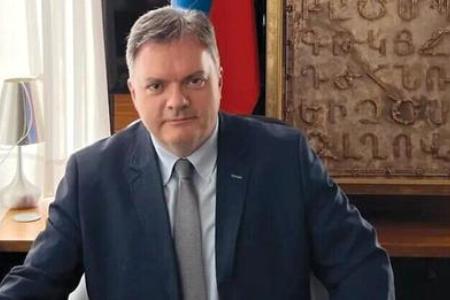
ArmInfo. Approximately 80% of Israeli society who speak out on this issue believes the country should have recognized the Armenian Genocide long ago. Armenian Ambassador to Israel Arman Hakobyan made this statement in an interview with Israel's Channel 9.
He clarified why Israel effectively recognized the Armenian Genocide, but then suspended the vote in the Israeli parliament. According to him, the official position of the country's Ministry of Foreign Affairs (MFA) is that the government's unanimous decision is sufficient grounds for Israel to be considered a country that has recognized the Armenian Genocide. "But something else is interesting. For many years, Israel has been criticized for failing to recognize the Armenian Genocide as a country that survived the Holocaust. Now, recognition has occurred, albeit very late, but the reaction has been mixed," the ambassador noted.
Specifically, he pointed to the differing positions on this issue among the government and civil society. "There are two sides here. One is the official position of the state, the other is the position of civil society. And if we talk about Israeli society, it cannot be denied: the overwhelming majority of civil activists and public figures have always advocated for the recognition of the Armenian Genocide. I analyze publications in the press and social media, monitoring comments under articles. According to my observations, approximately 80% of people who speak out on this topic believe that Israel should have recognized the Armenian Genocide long ago. Those who completely deny the fact of the genocide are very few. There are also people who acknowledge that the genocide occurred, but believe that the state should not make political recognition," the ambassador said. Hakobyan also noted the fact that support for recognition is somewhat lower among the Russian-speaking segment. He put it at around 75-80%. "One would think that there would be greater understanding of the Armenian question among Russian-speaking Jews, given the historical closeness of the two peoples and the large number of mixed families. Overall, it's surprising that in a society with such historical closeness between Armenians and Jews, the issue is perceived ambiguously. When I was asked about this before, I avoided political comments. But I did say one thing: recognition reflects a stance that has long existed in Israeli society. In fact, the state's official stance has finally come closer to public demand," Hakobyan said.
The diplomat also commented on the reports that emerged after this move, asking whether this was a "moral or geopolitical" decision. Specifically, he said, people were asking: is this historical justice or political calculation? "It's important to understand: Armenia has never asked other countries to recognize the Armenian Genocide. For us, this is not the basis for bilateral relations. We have excellent relations with many countries that have not done so. Today, Israel became the 33rd country to officially recognize the Armenian Genocide (in fact, Israel suspended the vote in the Israeli parliament on the issue of recognizing the Armenian Genocide ed.). Initiatives for such recognition usually originate within the countries themselves, not from outside. This is also not the first time in Israel. This issue has been raised in the Knesset many times, with individual members of parliament and parties advocating for recognition. Several years ago, the relevant Knesset committee already considered this issue," Hakobyan recalled.
However, the diplomat doesn't believe this will dramatically change bilateral relations. He says this isn't a key factor in Armenia's relations with other countries. "We take this fact into account. Every state makes such decisions based on its own reasons. Over time, people forget the political circumstances, but the fact of recognition remains. With Israel, the circumstances will probably be remembered longer because there was much more discussion and attention around it," the diplomat believes.
The ambassador also commented on the attacks against Armenians in the Old City of Jerusalem. According to him, this is one of the factors that is drawing serious attention in Armenian society. He acknowledged that in recent years, hostile acts against Armenians and Christians in general in the Old City of Jerusalem have become more frequent. "It must be emphasized: this isn't just a problem for the Armenian community. It's a broader issue concerning manifestations of anti-Christianity. But there are also specific cases directed specifically against Armenians. For example, threatening graffiti, attacks on Armenian establishments, and attempts to exert pressure on Armenian property. When Armenian society sees such events and asks questions, it doesn't necessarily constitute anti-Semitism. Criticism of specific actions or inaction by the authorities is a normal part of public debate. If Armenians are attacked in any country and the police don't respond appropriately, people have the right to speak out," Hakobyan noted.
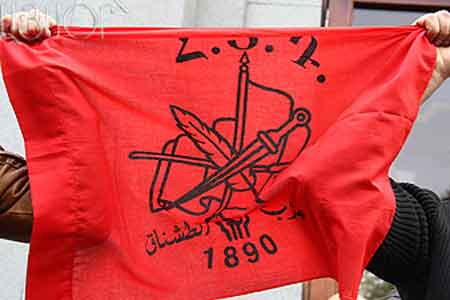
At the same time, he believes that some authors are trying to create the impression that Armenia is an institutionally anti-Semitic state. "For example, ASALA is often mentioned. But this organization ceased to exist in the early 1980s. It was primarily directed against Turkey and was not an anti-Semitic organization. If one wants to prove that anti-Semitism exists in a certain country, one can collect materials from fringe websites and individual extremist groups. But this does not paint the true picture of society. This does not mean that anti-Semitic manifestations have never existed in Armenia. They exist, as in any country in the world. But one cannot take isolated cases and create a picture of an entire society from them. It is also important to understand the difference between anti-Semitism and criticism of Israeli policies," the ambassador concluded.
Recall, on June 28, the Israeli government unanimously recognized the mass killings of Armenians in the Ottoman Empire during World War I as Genocide. The initiative was put forward by Israeli Foreign Minister Gideon Sa'ar. The document was then set to be submitted to the Knesset for approval. The Turkish Foreign Ministry sharply criticized this Israeli initiative. Turkey called the Israeli cabinet's actions politically motivated. Azerbaijan also condemned Israel's intention to recognize the Armenian Genocide in the Ottoman Empire. Specifically, the Azerbaijani Foreign Ministry issued a statement on June 29 calling on Israel to reconsider its position. On July 13, it was announced that Israel had suspended a critical vote in the Israeli parliament on recognizing the violence against Armenians by the Ottoman Empire during World War I as genocide.




















 Analyst: The primary issue with Armenia`s new Parliament Speaker`s speech lies is its one-sided interpretation of the causes of the political crisis
 Expert: Gagik Tsarukyan embodies post-Soviet model of big business-state relations; this model is used in many other post-Soviet countries
 Expert: Azerbaijan promoting aggressive plans against Armenia at state level
 Iranologist: Baku`s propaganda of might masks the country`s inability to provide water to its own population
 NA Vice Speaker candidate believes his wife`s salary as director of HayPost is the lowest in the company`s history
 RF Permanent Representative: There is no CSTO-Armenia conflict
 Moscow: NATO seeking to "Pull" Armenia away from CSTO Allies
  Political analyst: Russia intends to determine which "Camp" Armenia will choose through a referendum
 Narek Karapetyan will give up his parliamentary salary in favor of charitable contributions.
 Armenia and France discuss further development of strategic partnership and EU cooperation
  To overcome risks Armenia must reduce domestic escalation - expert
  Zatulin: Pashinyan was eager to get back to Russia because he actually lost the elections
 Human rights activist Ruben Melikyan dismissed from YSU
 Zakharova: Armenia`s pro-EU pivot poses economic security risks to EAEU member states
 It`s time for South Caucasus countries to think of South Caucasus as single, unified region - RA premier
  Pashinyan: Armenia and Azerbaijan should leave each other alone
 Moscow sees situation with Armenia as attempt to attack Russia-involving integration associations - Russian presidential aid