
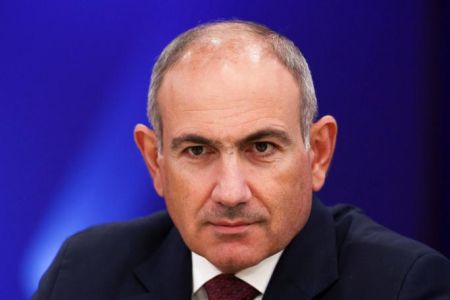
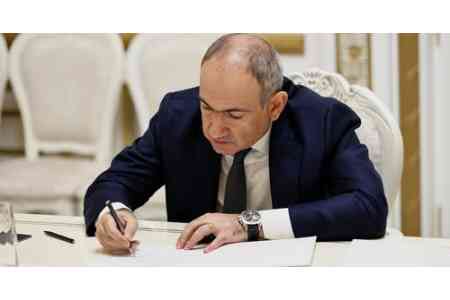
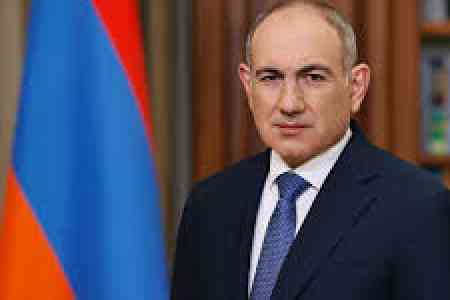
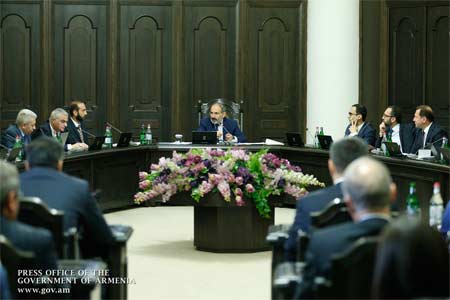
ArmInfo. It's crucial to understand that without the ability to implement its fundamental principles, the EAEU will face a crisis. Armenian Prime Minister Nikol Pashinyan stated this in Kyrgyzstan during a conversation with journalists. He called the situation with Armenian goods not only a problem for the Republic of Armenia but also a major problem for the EAEU.
"Because in practice, it turns out that the EAEU isn't working. If the principles aren't working, then neither is the EAEU," the Prime Minister remarked. He also noted that not only Armenia but also other countries are pursuing a policy of diversification, which is the sovereign right of each country.
"I've already said that our goal is to create alternatives for the Republic of Armenia. I think this is the legitimate right of any country, and everyone is working on it. At this point, torpedoing this process is not the best position for the EAEU. On the contrary, we need to work on increasing the competitiveness and attractiveness of the EAEU. This is the right approach, and the Republic of Armenia is ready to work in this direction," Pashinyan noted.
When asked by media representatives whether Armenia should choose between the EAEU and the EU, the Prime Minister responded that the choice itself must first be created. He said he had taken note of the statement of his EAEU colleagues of May 29 and respects it.
"By the way, an interesting detail: my colleagues support the idea of holding a referendum on Armenia's accession to the EU. I highly value this position. The referendum will take place, but only after Armenia officially applies to the EU for accession, and after institutional work on it begins. Holding a referendum today is impossible because there is no subject. Let's imagine that we now organize a referendum for the people of Armenia to decide whether to join the EU or the EAEU.
What will be the reaction? 'What are our prospects for becoming EU members?' 'What is our roadmap?'- and many questions will arise that neither we nor anyone else has answers to today," the head of government said.
What is happening in the EAEU space, namely the restrictions imposed by the Russian side, according to Pashinyan, only provokes a negative perception of the Eurasian Union in Armenia.
When asked whether the Prime Minister had compared Armenia's trade volumes with the EU and the EAEU, he responded that the issue wasn't about comparison, but about creating alternatives for the Republic of Armenia.
"Incidentally, some of our EAEU colleagues themselves, to some extent, provoked this process by declaring that Armenia wasn't needed or welcome anywhere. We took this not negatively, but positively, and began working to demonstrate that the reality is quite different," he noted.
Responding to a question about whether Armenia was being pressured to sever all humanitarian ties with Russia, the Prime Minister said the following: "If someone has the leverage to force someone to do something, it certainly isn't in Brussels, the West, the South, or the East."
According to the RA Statistics Committee, Armenia's foreign trade turnover with the EAEU countries decreased by 19% in the first half of the year, amounting to $2.8 billion. Exports totaled $1.3 billion, a 4.2% year-on-year decline, while imports fell by 28.8% to $1.5 billion.
Foreign trade with the EU increased by 46.2% during the reporting period, amounting to $1.7 billion. Specifically, exports increased by 80.2% to $516.5 million, while imports increased by 35% to $1.2 billion.









 Analyst: The primary issue with Armenia`s new Parliament Speaker`s speech lies is its one-sided interpretation of the causes of the political crisis
 Expert: Gagik Tsarukyan embodies post-Soviet model of big business-state relations; this model is used in many other post-Soviet countries
 Expert: Azerbaijan promoting aggressive plans against Armenia at state level
 Iranologist: Baku`s propaganda of might masks the country`s inability to provide water to its own population
 NA Vice Speaker candidate believes his wife`s salary as director of HayPost is the lowest in the company`s history
 RF Permanent Representative: There is no CSTO-Armenia conflict
 Moscow: NATO seeking to "Pull" Armenia away from CSTO Allies
  Political analyst: Russia intends to determine which "Camp" Armenia will choose through a referendum
 Narek Karapetyan will give up his parliamentary salary in favor of charitable contributions.
 Armenia and France discuss further development of strategic partnership and EU cooperation
  To overcome risks Armenia must reduce domestic escalation - expert
  Zatulin: Pashinyan was eager to get back to Russia because he actually lost the elections
 Human rights activist Ruben Melikyan dismissed from YSU
 Zakharova: Armenia`s pro-EU pivot poses economic security risks to EAEU member states
 It`s time for South Caucasus countries to think of South Caucasus as single, unified region - RA premier
  Pashinyan: Armenia and Azerbaijan should leave each other alone
 Moscow sees situation with Armenia as attempt to attack Russia-involving integration associations - Russian presidential aid