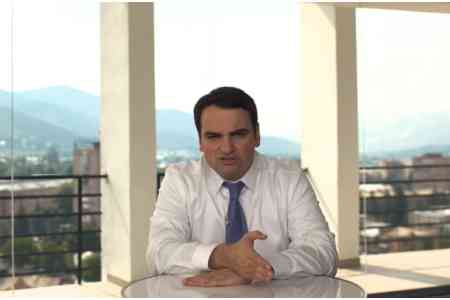
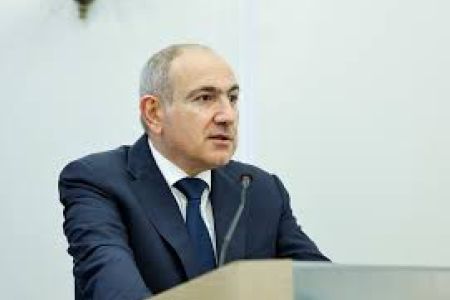
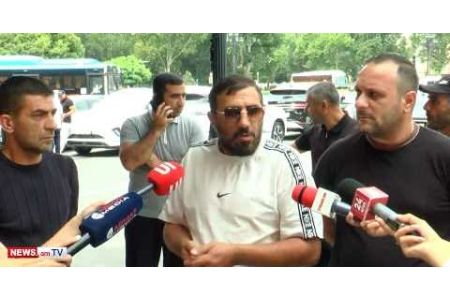
ArmInfo.Armenia has not yet fully recovered from the 2020 war, yet it is already being pushed into creating a new adversary in the form of Russia. This was stated by Narek Karapetyan, a member of the political council of the "Strong Armenia" bloc, in a conversation with journalists on July 31.
According to him, Armenian Prime Minister Nikol Pashinyan aims to ensure that no one else in the country engages in politics except for his appointed satellites. "However, it cannot be this way—we must have the opportunity to engage in political activity in our country. Because he (the Armenian Prime Minister — Ed.) is leading Armenia in the wrong direction, exacerbating its relations with other countries," Karapetyan believes.
The politician recalled how Pashinyan once similarly steered the country toward an escalation of relations with Azerbaijan, which ultimately led to the 2020 war. Today, in his view, the country is once again heading toward escalation, but this time with a nation that surpasses Azerbaijan in scale—Russia. As the bloc's political council member reminded, in the case of Azerbaijan, this led to war.
"We have not yet managed to digest that war; why should we create a new adversary? One cannot speak to the world driven by emotions. All decisions must be balanced so that we do not face the same consequences," Karapetyan stated.
Pashinyan must negotiate rather than complain, he noted. As an independent country, Armenia must do everything possible to prevent further deterioration of relations with other nations. Those who welcome the escalation of ties with Russia today are the same people who once welcomed the deterioration of relations with Azerbaijan ahead of 2020, Karapetyan pointed out.
At the same time, he clarified that when speaking of a new escalation, he does not mean a new war. Rather, he is referring to deepening contradictions and an economic standoff.
"As we already stated during the pre-election period, the military phase is over. The conflict has moved into a different phase," the political council member explained.
Karapetyan also drew attention to the extensive presence of Azerbaijanis and Turks in the region today. He believes a similar scenario could happen to Armenia: first through economic presence, and subsequently through political influence, potentially forming a distinct sphere of influence within the country.
"Meanwhile, we must remember that 65% of Armenia's trade turnover is tied to Russia. It is good that there is an Armenian shop in France; I am glad for that. But will selling our apricots there ensure a decent living for our villagers? The issue is not who is right and who is wrong. The main thing is to independently conduct our own policy, maintain emotional stability, and know how to negotiate. We are a sovereign state—no one owes us anything, and we owe nothing to anyone. But we are obligated to build our relations correctly. Imagine, being a landlocked country, we managed to sell fish to Russia, which is bordered by more than eight seas," Karapetyan concluded.








 Iranologist: Baku`s propaganda of might masks the country`s inability to provide water to its own population
 Analyst: Continued tensions between Yerevan and Moscow could entail new restrictive measures from Russia
 Political analyst: Russia intends to determine which "Camp" Armenia will choose through a referendum
 Armenia and France discuss further development of strategic partnership and EU cooperation
  To overcome risks Armenia must reduce domestic escalation - expert
  Zatulin: Pashinyan was eager to get back to Russia because he actually lost the elections
 Pashinyan removed from INNOPROM guest list
 Zakharova: Armenia`s pro-EU pivot poses economic security risks to EAEU member states
 It`s time for South Caucasus countries to think of South Caucasus as single, unified region - RA premier
  Pashinyan: Armenia and Azerbaijan should leave each other alone
 Moscow sees situation with Armenia as attempt to attack Russia-involving integration associations - Russian presidential aid
 Zakharova: Armenia views relations with Russia as tool for financially securing reorientation toward EU
 The Armenian Minister of Justice and the EU Ambassador discussed visa liberalization issues for Yerevan.
 Azerbaijan`s aggressive plans against Armenia became possible in wake of Pashinyan`s decisions on Artsakh - expert
  Zakharova: Russia sent a note of protest to Armenia over the act of vandalism at the "Mother Armenia" memorial in Gyumri