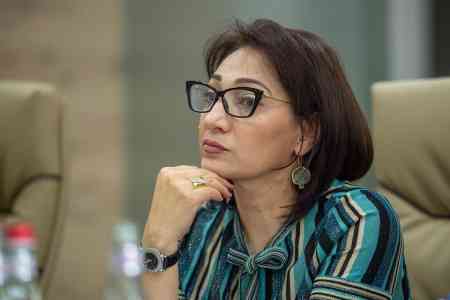
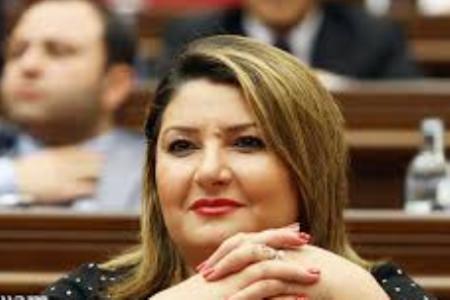
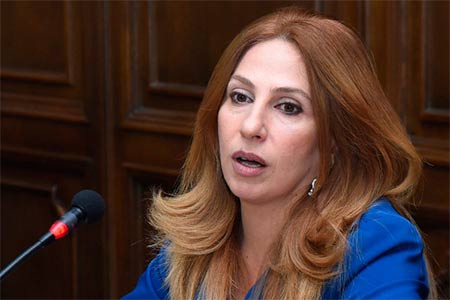
ArmInfo. Below is a statement Lilit Galstian, a member of the RA delegation to the OSCE PA representing the opposition faction Armenia, made at the 33rd session of the OSCE PA in The Hague.
Dear colleagues,
Each year we are discussing the state of human rights and democracy and each year the picture is becoming more troubling. As the report rightly stated: "Instead of strengthened co-operation, we are witnessing a widening gap between agreed standards and their implementation in practice."
This is not simply an emotional disappointment; but a serious concern about our ability to restore trust and to acknowledge our failures.
For the past four years, I have consistently raised two vital issues: the ethnic cleansing of Nagorno- Karabakh committed by Azerbaijan, and the democratic backsliding in Armenia.
At our Annual Session in Porto, I proposed sending an international mission to Baku to monitor the sham trials of former political leaders of Nagorno-Karabakh and to assess the ongoing erosion of Armenian cultural heritage. The proposal was not supported!
By failing to act, de we allowed Azerbaijan to continue its violations. Today, at least 19 Armenians- including Ruben Vardanyan, Bako Sahakyan, Arkadi Ghukasyan, Davit Ishkhanyan, Davit Manukyan, and others remain unlawfully detained. They continue to face torture and inhumane treatment, while even the Internation Red Cross has been denied access.
This is not an isolated injustice, but part of a broader policy that included the blockade of Nagorno- Karabakh, the forced displacement of its indigenous population, the destruction of Armenian cultural heritage, and the continued promotion of the so-called "Western Azerbaijan" a state-sponsored aggressive and false narrative used to advance territorial claims against Armenia.
By failing to respond we weaken the very standards that form the foundation of OSCE.
Unfortunately, Armenia is facing serious democratic challenges of its own. International organizations are expressing concern about the concentration of power and the weakening of democratic institutions.
Recent parliamentary elections were often portrayed as a geopolitical contest. While the majority of voters rejected further concessions, the crimes against democracy, the rising dictatorship, political prosecutions, unlawful attacks on Armenian Apostolic church.
Colleagues, our responsibility does not end with documenting these developments.
I, therefore, call on the Assembly to closely monitor the democratic decline in Armenia;
to demand the immediate release of all unlawfully detained Armenians;
to ensure the protection of the cultural heritage of Nagorno-Karabakh;
and to reaffirm the right of return of its indigenous population.
This is not simply a moral imperative; but a legal obligation. Let us restore trust in the principles we are committed to uphold.
The exact number of Armenian prisoners of war and hostages held in Azerbaijani prisons remains unknown. Experts estimate the number to be several hundred. Currently, Azerbaijani authorities confirm the presence of 19 Armenians in their custody. Among those held in Azerbaijani captivity are eight former and current members of the military-political leadership of Artsakh. These include former Artsakh presidents Arkady Ghukasyan, Bako Sahakyan, and Arayik Harutyunyan; former Foreign Minister David Babayan; as well as Parliament Speaker David Ishkhanyan; former Commander of the Artsakh Defense Army General Levon Mnatsakanyan; General David Manukyan; and former State Minister Ruben Vardanyan.
In February, a Baku puppet court sentenced Arayik Harutyunyan, David Babayan, David Ishkhanyan, David Manukyan, and Levon Mnatsakanyan to life imprisonment, and Bako Sahakyan, Arkady Ghukasyan, and Ruben Vardanyan to 20 years in prison on trumped-up charges. The so-called court sentenced the remaining Artsakh residents to up to 15 years in prison.








 RA Government guarantees high salaries for CC justices, Syunik families deprived of family benefits - politician
  Armenian experts, leading Turkish think tanks discuss prospects for expanding cooperation
  Political Scientist: As long as the opposition remains silent, Pashinyan can use Plan B and secure a constitutional majority
 Zakharova: Armenia`s pro-EU pivot poses economic security risks to EAEU member states
 It`s time for South Caucasus countries to think of South Caucasus as single, unified region - RA premier
  Pashinyan: Armenia and Azerbaijan should leave each other alone
 Moscow sees situation with Armenia as attempt to attack Russia-involving integration associations - Russian presidential aid
 Zakharova: Armenia views relations with Russia as tool for financially securing reorientation toward EU
 The Armenian Minister of Justice and the EU Ambassador discussed visa liberalization issues for Yerevan.
 Azerbaijan`s aggressive plans against Armenia became possible in wake of Pashinyan`s decisions on Artsakh - expert
  Zakharova: Russia sent a note of protest to Armenia over the act of vandalism at the "Mother Armenia" memorial in Gyumri
 Samvel Karapetyan proposes creating a post-election opposition coalition
 Artsakh`s Cultural Heritage Ombudsman called on Moscow to respond to destruction of WWII monuments by Azerbaijan in occupied NKR
 Dutch Prime Minister expresses his support for Armenia`s democratic reform and economic diversification agenda
 Heritage: It`s time for Armenia`s opposition to present people with legitimate alternative to power
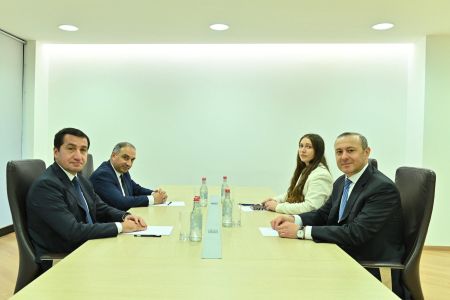 RA Security Council Sec, Assistant to President of Azerbaijan hold negotiations in Dilijan